

Miura Multiple Installation System
The Miura Multiple Installation System is what happens when boiler engineering finally catches up with how industrial facilities actually operate. Boiler Technologies Unlimited, Florida's authorized Miura MI System dealer, brings this platform to commercial and industrial operations across Tampa, Orlando, Miami, Jacksonville, St. Petersburg, Sarasota, Fort Lauderdale, and every major market in the state, with online sales and support reaching the full continental US.
Single large-shell boilers made sense when steam plants were designed around one big unit running continuously at full load. Most facilities don't operate that way anymore. Load fluctuations occur. Demand surges. Equipment requires servicing.
The Miura MI System was built for that reality.
What the Miura Multiple Installation System Actually Does
Strip away the marketing language and the Miura modular boiler system does three things that conventional steam plant designs cannot do as cleanly: it scales, it rotates, and it protects.
Scaling means adding or removing boiler units from the array without rebuilding the plant. A facility that needs 500 BHP today and 1,200 BHP in three years doesn't have to engineer for the future load from day one. The Miura modular steam plant grows with the operation.
Rotation means the system's control architecture automatically sequences which units run, how long they run, and when they cycle off for maintenance. No manual intervention. No unit running 80,000 hours while its neighbor sits idle.
Protection means redundancy is built into the architecture. A redundant steam boiler system doesn't require a dedicated standby unit sitting cold. Every boiler in the array can cover for any other unit, automatically, without operator input.
This is the structural case for the Miura Multiple Installation System over any single large-shell alternative, including the firetube platforms that still dominate a lot of legacy mechanical rooms.
The Problem with How Most Facilities Run Steam Today
Most jobs fall apart because of timing, not the work itself.
Facilities running Cleaver-Brooks, Hurst, Fulton, or comparable firetube equipment are usually managing steam with a system that was sized for peak demand and running at partial load most of the time. That's the nature of firetube design. You install for the worst case and run inefficiently the rest of the year.
The thermal mass of a large firetube boiler means startup takes time, load response is sluggish, and the unit doesn't modulate cleanly across a wide demand range. When maintenance is due, the whole plant is at risk unless a second full-size unit was installed as backup, which most facilities can't justify economically.
The scalable steam boiler system model solves this at the design level. Instead of one oversized unit, the MI System deploys multiple smaller Miura once-through watertube boilers in a coordinated array. Units begin their cycles roughly every five minutes. They run at their full capacity, avoiding the inefficiencies of partial load operation.
When one unit is offline, the others carry the load.
Boiler Technologies Unlimited has guided Florida facilities through this transition from legacy firetube equipment and the operational difference is not subtle. Less fuel. Less downtime. Less complexity in the maintenance schedule.
System Capacity: From Small Installations to 4,500 BHP
The Miura MI System scales from small commercial configurations up to full industrial steam plants. At the top end, the system supports a 4500 BHP modular steam system and a 150 MMBtu/hr steam plant output, which places it in the same capacity range as the largest conventional boiler room designs, without the single point of failure those designs carry.
That upper capacity figure is significant. Facilities that have historically believed large centralized steam plants were the only way to meet high-demand requirements now have a direct alternative in a modular boiler room design that doesn't require betting the whole plant on one unit's continued operation.
Control Architecture: BP-201 and MP1
This is usually where people run into problems with modular systems from other manufacturers. The hardware itself is perfectly adequate. The controls, however, seem to have been given little consideration.
Miura's control infrastructure is purpose-built for multi-unit operation. The BP-201 boiler controller governs individual unit operation, monitoring performance parameters, managing combustion, and feeding data upstream to the system-level controller.
Above that sits the MP1 master boiler controller , which coordinates the entire array. The MP1 functions as the boiler load management system for the installation, deciding in real time which units are active, at what output level, and in what rotation sequence. When demand rises, the MP1 brings additional units online. When demand drops, it stages units off in sequence. The automated boiler staging system handles all of this without operator intervention.
The practical result is a steam plant that self-manages across the full demand range. Operators monitor rather than manually sequence. Maintenance windows are scheduled by the system based on runtime hours rather than guessed at. And because the MP1 tracks performance data across all units simultaneously, degradation in any single boiler surfaces before it becomes a failure event.
For Florida facilities with limited boiler room staffing, that level of automated management isn't a premium feature. It's what makes the system viable on a day-to-day basis.
Redundancy Without Dedicated Standby Units
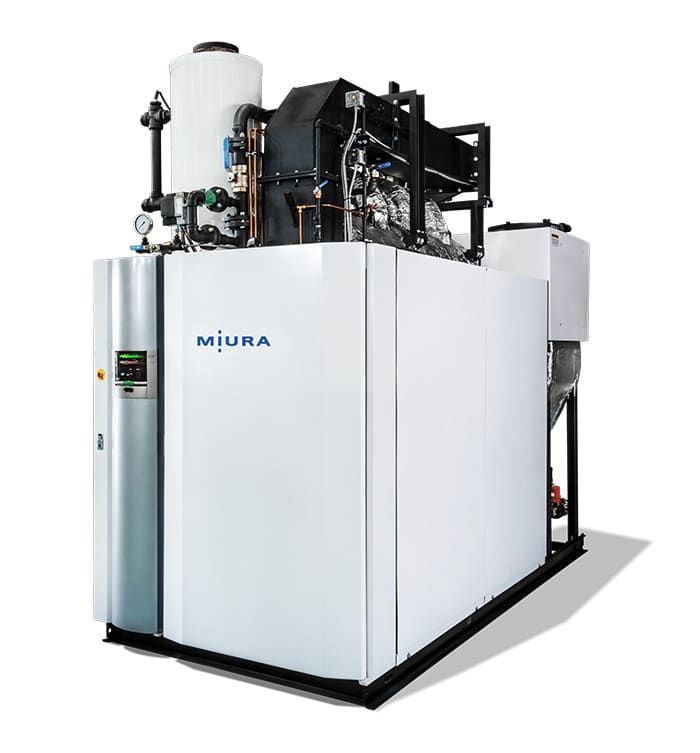
The redundant boiler backup system design of the MI System deserves its own discussion because it changes the economics of steam plant redundancy entirely.
Traditional redundancy means buying a second boiler. Full size, fully equipped, sitting mostly idle. That's a significant capital expenditure to protect against downtime, and it's the only option available in a single-boiler plant design.
In the Miura MI System, redundancy is a function of the array. If the installation includes five units and peak demand requires four, the fifth is available as immediate backup for any unit that goes offline. The Miura on-demand steam system architecture means that fifth unit is hot-standby capable, reaching full steam in five minutes when called upon.
Redundant steam boiler system performance doesn't require a separate investment. It's a byproduct of the modular configuration. For pharmaceutical and healthcare facilities in Florida where steam interruption has direct regulatory and patient care implications, that redundancy model is a significant operational advantage over any firetube-based alternative.